After one of the hottest summers on record, the humble pond is needed more than ever in the South Downs National Park.
Six new ponds will now be created or restored for nature as the National Park’s Pounds for Ponds scheme announces a new tranche of projects.
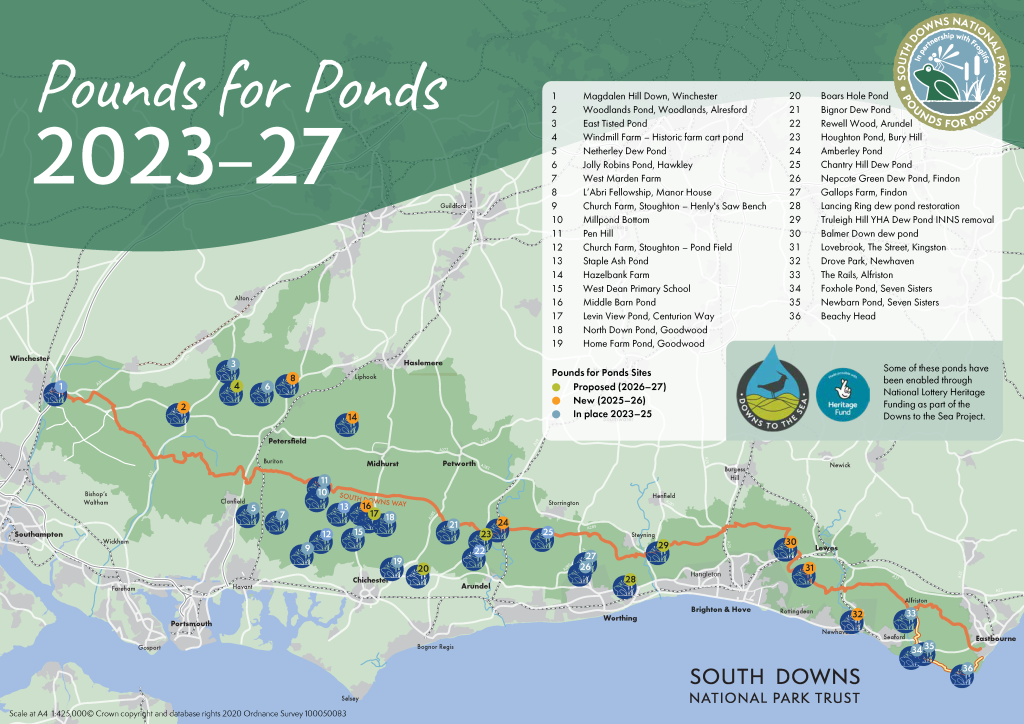
Over the past three years more than 30 ponds across Sussex and Hampshire have been transformed into havens for wildlife and now several more are in the offing.
Dew ponds are synonymous with the chalk grassland of the South Downs, historically being dug by farmers as a watering hole for livestock and some dating back several hundred years.
However, over many decades and due to changes in farming practices, scores of these wildlife oases have fallen into disrepair or been lost completely. Climate change, with warmer, drier summers, has worsened the problem, meaning these bodies of water are more important than ever in providing refuge and drinking water for insects, birds, amphibians and mammals.
The South Downs National Park Trust, the official independent charity for the National Park, launched Pounds for Pond with the aim of reversing the decline and has been working with the National Park Authority and a variety of landowners and farmers.
The initiative is being run in partnership with pond specialist and wildlife charity Froglife, with the aim of raising £1m to restore 100 ponds in total. Funding so far has come from public donations and support from the National Lottery Heritage Fund, Bannister Trust, BMW, Ernest Kleinwort Charitable Trust, Portsmouth Water, Froglife and Swire Charitable Trust.
More than £325,000 has been invested so far creating or restoring ponds.
The National Park is celebrating the success of the initiative by releasing a series of beautiful new films that show the transformation of the ponds.
Jan Knowlson, Biodiversity Officer for the South Downs National Park, said: “Water in the landscape is vital for biodiversity and needed more than ever amid a changing climate, with increasingly hotter, drier summers.
“Just a century ago there may have been 1,000 or so ponds across the South Downs landscape and so many of these have been lost, so Pounds for Ponds is really important to help nature bounce back.
“Ponds are a particularly important habitat in the agricultural landscape, supporting the highest number of freshwater plant species and some of the rarest species, such as the fairy shrimp, great crested newt and the scarce blue-tailed damselfly.
“We’d like to thank each and every individual and organisation who has helped us so far as none of this really crucial nature recovery work would be possible without their support.”
The six new projects are:
- Lancing Ring, West Sussex – restoration of dew pond at a Local Nature Reserve popular with walkers. The scheme will help link the South Downs to the local residential area and is being run in partnership with Adur and Worthing Council.
- Houghton Pond, Bury Hill, West Sussex – Creating a new pond at Houghton Hill along the South Downs Way.
- Levin View, Singleton, West Sussex – Creation of new wildlife pond with planting near the newly-renovated Centurion Way walking and cycling route.
- Truleigh Hill Camping Field, Youth Hostel Association (YHA), West Sussex – Restoration of dew pond, including removal of invasive species like Canadian Pond Weed.
- Boars Hole Pond, Eartham, West Sussex – Installation of a pond to create new important habitat, food and water source for local wildlife, located at the end of and linked to Chichester District Council’s strategic nature corridors project.
- Windmill Farm, Colemore, Hampshire – Re-instatement of a historic farm cart pond accessible along a country road.
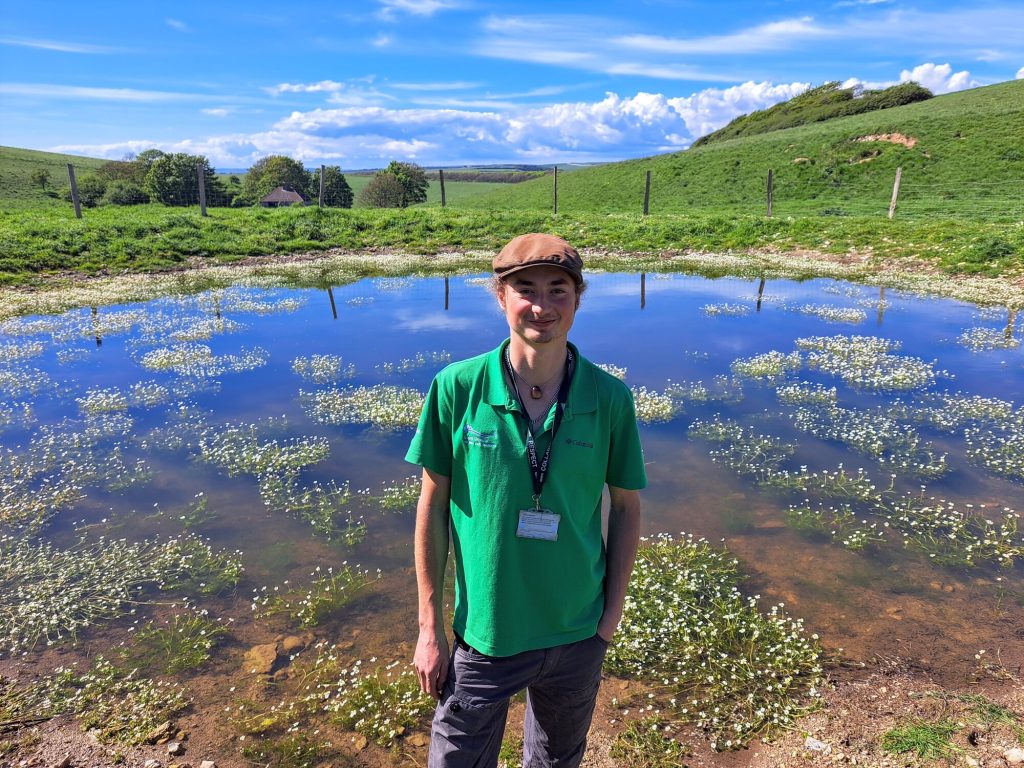
Life is returning to ponds that have been restored so far, including at Seven Sisters, where meadow pipits, goldfinch and starlings are flocking to drink and dragonflies are buzzing around. Newts, toads and frogs have also moved in to create a rich wildlife oasis.
National Park Ranger Lawrence Leather (pictured above) said: “When I started here, this pond was completely dry most of the year and the concrete lining had cracked, so it just wasn’t holding any water.
“With Pounds for Ponds, we got funding to reline the pond and it started holding water within weeks. It’s so valuable because chalk grassland can be a very dry landscape and the water just permeates into the ground.
“Having a place to capture the water brings loads of different species in, such as dragonflies, newts, frogs and toads. It’s also great for bird species that are moving through the landscape, stopping for a drink. It’s now such an abundant mix of species and you wouldn’t see that without the wet landscape.”
New ponds are also being created as part of other projects in the National Park, including the National Lottery Heritage Fund-Downs to the Sea. Pounds for Ponds is one strand of the National Park’s #ReNature initiative, which is aiming to create 13,000 hectares of new land managed for nature over the next decade to help tackle the biodiversity crisis. Find out more at www.southdowns.gov.uk/renature/ The National Park Authority has also prioritised water in the landscape as part of its five-year Partnership Management Plan.
To donate to Pounds for Ponds, visit https://southdownstrust.org.uk/pounds-for-ponds/